


2026 has been a punishing year at the pump. Fuel climbed to record highs, passing R25 a litre, and for most South African households – where transport is one of the biggest fixed monthly costs – every increase lands straight on the budget.
People have responded by changing how they use rewards. Across the market, loyalty programmes are no longer treated as a nice-to-have; they’ve become a practical way to claw back some of the cost. Consumer commentators have noted the same shift, as fuel costs jumped, more people turned to loyalty programmes to help bear the load, and rewards are increasingly seen as money-saving tools rather than perks.
We saw it happen in our own network, and the pattern is striking.
What the data shows
For the first three months of the year, while petrol sat near a multi-year low, people converted their rewards into value at a steady, routine pace – roughly 51 conversions a month, nothing unusual. Then fuel spiked: a R3.02 jump at the pump in a single month, climbing to a record R25.76 a litre by May.
The response was immediate, and it showed up in three ways at once.
People converted far more often. Conversions more than doubled – up 112% between the calm first quarter and the months after the price shock.
They converted bigger balances. The average amount people processed rose 136%. And tellingly, the typical (median) conversion rose even more – up 264%. That gap matters: when the median climbs faster than the average, it means this wasn’t a handful of big users skewing the numbers. The behaviour was broad. Ordinary people, across the board, were reaching deeper into their rewards.
And the total value mobilised more than quadrupled (up over 400%) as people put accumulated rewards to work precisely when money was tightest.
Here’s the part that matters most for any business running a programme: this surge came entirely from users. People chose to use what they’d been quietly accumulating, the moment the cost of living bit. The median amount processed jumped from around R35 early in the year to over R200 once fuel peaked, and then held there.
Look at the two sides of the platform side by side. On one side, the value made available grew along its own gradual path. On the other, user demand sat low and steady for months, then spiked sharply the moment fuel did. The supply line never jumped; the demand line did. People simply chose to use what they’d been quietly accumulating, the instant the cost of living bit.
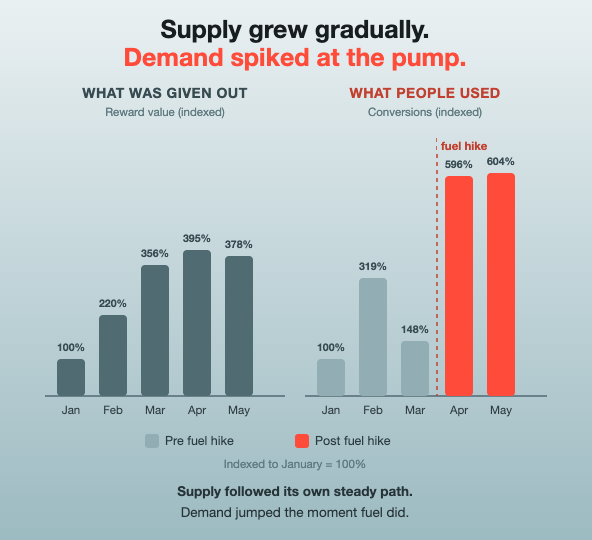
This wasn’t a one-week reaction to a headline. As prices stayed high, the behaviour stayed with it, month after month. Rewards had become part of how people manage real costs, not an occasional treat, but a tool they reach for.
The real, organic behavioural change began the day the increase hit the pump. And it was strongest in high-commuter provinces – Gauteng led the response, exactly where people depend most on their cars.
The takeaway for businesses is simple: in a tough economy, customers don’t just appreciate rewards, they actively rely on them. Which raises the real question for any brand or employer: is your programme built for that?

What it means for your business
The lesson underneath all of this: a rewards programme earns its keep not in the easy months, but in the hard ones. When it shows up for people exactly when they need it, it stops being a marketing line and becomes something they depend on, and that’s what real loyalty is built on.
Here’s how that translates into practice.
If you run a loyalty program (retailers & brands)
- Make rewards immediate. When people are under financial pressure, they want relief now, not points that vest someday. The more instantly a reward can be felt, the more it matters.
- Tie value to costs people actually feel. Rewards that help with essentials – fuel, groceries, everyday spend, land far harder right now than aspirational or novelty perks.
- Strip out the friction. Every extra step between earning and redeeming is a place people drop off. The best programmes make redemption effortless, at the till, in the app, no hoops.
- Meet customers where they already are. Don’t make people download, remember, or carry one more thing. Rewards that live inside the way people already pay and shop get used; the rest get forgotten.
- Choose utility over flash. In a hard year, “useful” beats “exciting.” Practical, reliable value builds more goodwill than a flashy campaign that’s awkward to redeem.
- Be consistent. Customers notice which programmes show up when it counts. Reliability through tough times is what converts a user into a loyal one.
If you reward your staff (employers)
1. Give value people feel immediately. The most appreciated staff rewards right now are the ones that ease a real, current cost, not a perk they’ll use “someday.”
2. Make it relevant to the moment. Help with everyday pressures (fuel, essentials) reads as genuine care, not a token gesture.
3. Offer choice. People’s pressures differ, flexibility in how a reward is used makes it land for everyone.
4. Keep it easy to run at scale. A reward programme that’s painful to administer rarely lasts. The simpler it is to buy, distribute and track, the more consistently you can show up for your team.
Read More: How Loyalty Reward Structures Change Customer Behaviour in South Africa
How Yoyo helps
This is exactly the kind of reward experience we build. Yoyo powers immediate, frictionless reward and voucher experiences, value people can feel and redeem without friction, inside the ways they already pay and shop.
And for businesses buying rewards rather than running a programme, Wrapped, our giftcard marketplace and corporate gifting platform, lets you purchase vouchers in bulk from one place, for employee rewards and incentives, staff allowances, or general gifting.
Fuel will probably stay expensive, and customers and staff will keep feeling it. But that’s precisely the moment a well-built rewards programme proves its worth, by showing up when it counts. The businesses that get this right won’t just retain customers through a hard year. They’ll earn the kind of loyalty that lasts well beyond it.